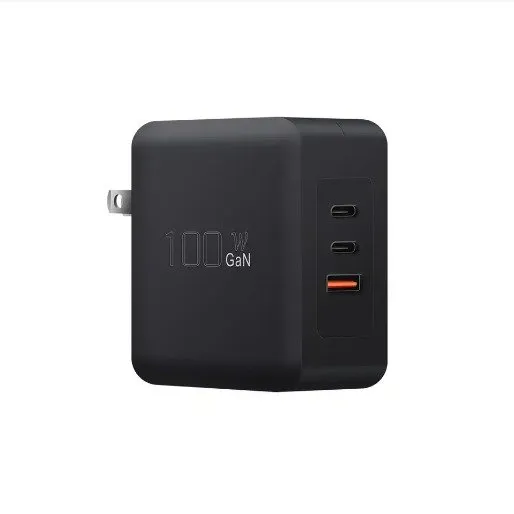
Price range: $69.95 through $79.95 Inc GST
One plug that charges the laptop at full speed and still has ports left over. A 100w usb c charger is the point at which a single wall socket replaces the pile of bricks under the desk — laptop, phone and tablet from one gallium nitride charger that fits in a coat pocket.
100W is 20V at 5A, and on a 100w usb c charger that is the rating most 13- and 14-inch laptops charge at flat out. A 16-inch machine will charge from it too, just more slowly under full load — which in practice means it holds its charge while you work rather than climbing.
The 100W figure is the single-port maximum, as it is on every multi-port charger ever made. Plug in a second device and the power is shared. Most listings leave that unsaid; here is what actually happens on the two-port version:
On a 100w usb c charger you lose thirteen watts, not half. That is the number worth knowing, and it is better than most chargers in this class manage — a laptop on 87W still charges while you work, and the phone on the other port gets a proper 12W rather than a trickle. The full table is in the specifications.
Older chargers use silicon. Gallium nitride switches faster and wastes less energy as heat, which means a smaller transformer, a smaller case and a part that runs cooler doing the same job.
The practical version: this is a 100w usb c charger roughly the size of the 60W brick your laptop came with, and it replaces a charger, a phone plug and a tablet plug with one thing in the bag. On a desk this usb c wall charger frees two sockets. In a suitcase it is the difference between a packing cube of chargers and one item.
If you are charging one laptop and nothing else, take the two-port 100w usb c charger. If you are the person whose bag has a laptop, a phone and a set of earbuds in it, the three-port version is worth the few dollars — a usb c wall charger you have to unplug something from is a usb c wall charger you end up leaving at home.
A 100w usb c charger is not one speed for everything — it negotiates with whatever is plugged into it and delivers what that device asks for.
At or near full rate: 13- and 14-inch USB-C laptops, most Windows ultrabooks, Chromebooks, and portable monitors. Comfortably: phones, tablets, handheld consoles, earbuds and anything that would otherwise use a 20W or 30W plug — all of which draw far less than the charger can give and are in no danger from the headroom.
Slower than its rating: 16-inch and workstation laptops that ask for 140W or more. They will still charge from a 100w charger, just not at their maximum, and they will usually hold level rather than drain while in use.
A device never draws more than it asks for. A phone on a 100W charger takes its usual 20-something watts and no more — the negotiation runs the other way round from how people assume, which is worth saying because “will it damage my phone” is the most common question about a charger this size. It will not.
This is the part most listings skip, and it undoes more 100w usb c charger purchases than any fault in the charger. 100W here is 20 volts at 5 amps, and 5A needs a cable built for 5A — a USB-C lead with an e-marker chip rated to 5A, not the 3A lead that came with your phone. A 3A cable will work; it will just cap the charger at 60W and give you no warning that it has.
If your laptop charges slowly from a 100w usb c charger, the cable is the first thing to check and the charger is the last. We stock 5A e-marked 100W and 240W leads and will point you at the right one — or tell you the one you already own is fine.
RCM certified for sale in Australia, which on a mains product is the fact that matters most and the one the marketplace listings quietly skip. The certificate is on file and we will send it to you if you want to see it.
Black or white, same internals either way. This usb c wall charger plugs straight into an Australian socket with no travel adapter and no lead to the wall — the other quiet advantage of a gallium nitride design in a 100w usb c charger is that the whole thing is the plug.
Stocked in Melbourne with 6 on the shelf, not drop-shipped. Order before 10am and your 100w charger ships the same day via Australia Post with tracking and insurance, backed by our 180-day warranty and a team who will tell you whether your laptop can actually take 100W before you spend seventy dollars.
One plug instead of three. Order your 100w usb c charger today.
Charges at or near its full rate:
Charges comfortably, well below the limit:
Charges, but not at its own maximum: 16-inch and workstation laptops rated for 140W or more. They will charge and will generally hold level while you work; they will not reach their fastest rate from a 100W supply.
A device only ever draws what it asks for. USB Power Delivery negotiation runs from the device, not the charger, so a phone on this charger takes its usual twenty-odd watts and no more. The headroom is not a risk.
Two things decide whether you see the full 100W.
First, what else is plugged in. On the two-port version the USB-C port gives 20V/5A — the full 100W — on its own, and 87W with the USB-A port also in use, which takes 12W. The USB-A port on its own gives up to 18W. Those figures are in the specifications.
Second, the cable. 100W here means 20 volts at 5 amps, and 5A needs a USB-C lead e-marked for 5A — not the 3A cable that came with a phone, which looks identical and will quietly cap the charger at 60W. Ask us and we will tell you whether the one you own is up to it.
RCM certified for sale in Australia, with an integrated Australian plug — no travel adapter, no lead to the wall. On a mains-powered product the approval is the specification that matters most, and we hold the certificate.
Core Connect Aust is not affiliated with, endorsed by, or sponsored by Apple, Dell, Lenovo, HP, Asus, Microsoft, Samsung, Google, Nintendo or Valve. All brand and model names are trademarks of their respective owners, used here for compatibility reference only. This is not a manufacturer-branded product.
Only logged in customers who have purchased this product may leave a review.


Reviews
There are no reviews yet.