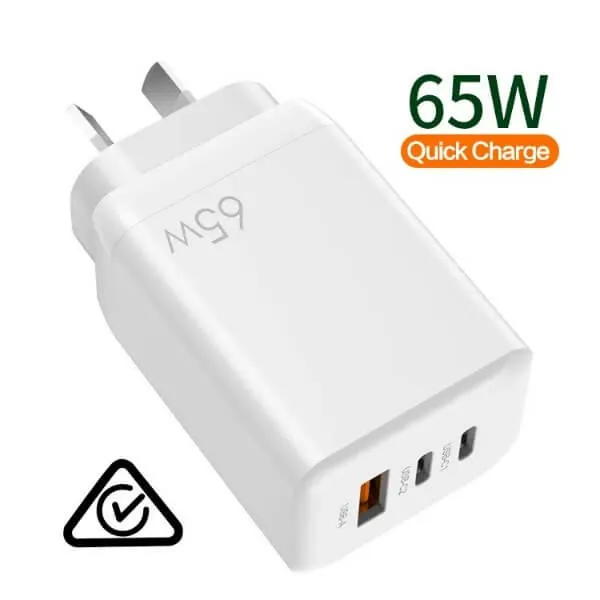
$49.95 Inc GST
Sixty-five watts is the number that matters. It is the point where a wall plug stops being a phone accessory and starts running a work machine — a MacBook Air, a Dell XPS 13, a ThinkPad, a Framework — at full speed with the lid open. A 65w usb c charger is the one brick that replaces the one your laptop came with, and still has ports left over.
Two USB-C and one USB-A. What makes it a dual usb c charger rather than a single-port brick with an extra socket is that both C ports negotiate USB Power Delivery properly. The layout is deliberate: the laptop lives on the first USB-C port, the phone or tablet on the second, and the USB-A port keeps whatever you own that still ends in a rectangle — a headset, a power bank, a set of earbuds, a controller.
USB-C1 steps through 5V, 9V, 12V, 15V and 20V at 3.25A, so 65W at the top.
The USB-A port runs 5V/3A, 9V/2A and 12V/1.5A — 18W, the Quick Charge 3.0 ladder, and plenty for anything built before USB-C took over.
This is the part most listings leave out, and it is the part that decides whether you are happy with the thing.
A 65w charger has 65 watts to give, not 65 watts per port. Plug in a second device and the supply divides. The published figures:
Read the first two rows, because they are the ones you will live in. A laptop on C1 with a phone alongside keeps 45W, which still charges a 13-inch ultrabook while you work — slower than 65W, not dramatically so, and the phone is full in an hour either way.
⚠️ And read the third row before you assume. USB-C2 + USB-A together are 15W — a fifth of what C1 and USB-A manage. If your habit is to leave the laptop unplugged and use the two smaller ports, this dual usb c charger behaves very differently from what the headline suggests. We have asked the supplier what USB-C2 delivers on its own and will publish the figure when we have it rather than guess at it.
A 13-inch ultrabook, at full speed. MacBook Air, XPS 13, ThinkPad X1, Surface Laptop, Framework 13 — all ship with 45W to 65W bricks, and this replaces them outright.
A 14 or 16-inch machine, more slowly. A MacBook Pro 14 will charge from a 65w usb c charger; it just will not hit the speed its own 96W brick manages. For overnight and for desk work that is a distinction without a difference.
Everything below a laptop, instantly. Phones, tablets, earbuds, handhelds, a Steam Deck, a drone battery. 65W is the tier where one brick covers a whole bag — which is the case for a 65w gan charger over three separate plugs.
Gallium nitride switches faster and wastes less as heat than the silicon in an older power supply, so the same wattage fits in a much smaller shell. A 65w charger built this way is roughly the size of the 30W brick from a few years ago and lighter than the one in your laptop bag now.
65W is 20V at 3.25A, and a plain USB-C cable is built for 3A. Above that a cable needs an e-marker chip rated for 5A.
So a 3A lead through this charger gives you 60W, not 65W. That is a difference you will never notice on a laptop, and we would rather say it than let you measure it and wonder. If you want the full figure, use a 5A e-marked lead — we stock them, and the same cable serves the 100W brick if you move up later.
The charger carries the Regulatory Compliance Mark — the triangle-and-tick you can see on the product itself.
That is the mark Australian law requires, and it covers three things: electrical safety to the AS/NZS standards, electromagnetic compatibility, and a registered Australian supplier standing behind the declaration. A large share of GaN bricks sold into Australia through marketplaces carry none of it. We hold the certificate and will send it to you if you ask.
On top of that: overcurrent, overvoltage, short-circuit and over-temperature protection, and a flame-retardant polycarbonate shell.
Fixed Australian pins — no adapter, no wobble in the socket. Input is 100V to 240V, so a plug adapter is all it takes to use the same 65w gan charger in Europe, Japan or the United States.
Stocked in Melbourne, not drop-shipped, and RCM marked rather than hoping nobody checks. Order before 10am and your 65w charger ships the same day via Australia Post with tracking and insurance, backed by our 180-day warranty and a team who will tell you which port to put the laptop in.
One brick, three devices, a work machine at full speed. Order your 65w usb c charger today.
Laptops that charge over USB-C — at full speed:
Larger machines — they will charge, just not at their own top rate:
Phones, tablets and everything smaller — at their maximum:
One brick, three devices — and the split is worth knowing. Put the laptop on USB-C1; that port holds 45W even with something on every other socket. USB-C2 and USB-A together deliver 15W, which is fine for two phones overnight and is not a second laptop port. See the power-sharing table in the specifications.
The cable matters for the last five watts. 65W means 20V at 3.25A, and a plain USB-C lead is rated for 3A — so an ordinary cable gives you 60W. Use a 5A e-marked lead for the full figure. Any USB-C cable will charge a phone at its maximum regardless.
Travel. Input is 100–240V, so the charger works anywhere with a plug adapter. The pins themselves are Australian and fixed.
RCM marked. Electrical safety to the AS/NZS standards, electromagnetic compatibility, and a registered Australian responsible supplier behind it — the mark Australian law requires on mains equipment. We hold the certificate and will send it on request.
Core Connect Aust is not affiliated with, endorsed by, or sponsored by Apple, Dell, HP, Lenovo, Microsoft, Samsung, Google, OnePlus, Oppo, Xiaomi, Nintendo, Valve or ASUS. All brand and model names are trademarks of their respective owners, used here for compatibility reference only. This is not a manufacturer-branded product.
|
Ports in use |
Output |
|
USB-C1 alone |
65W |
|
USB-A alone |
18W |
|
USB-C1 + USB-C2 |
45W + 20W |
|
USB-C1 + USB-A |
45W + 18W |
|
USB-C2 + USB-A |
15W combined |
|
USB-C1 + USB-C2 + USB-A |
45W, then 15W shared |
Only logged in customers who have purchased this product may leave a review.


Reviews
There are no reviews yet.