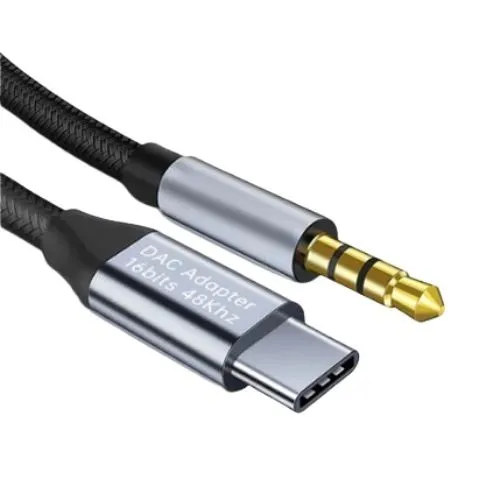
Price range: $12.99 through $17.99 Inc GST
Your phone stopped having a headphone socket. Everything you want to plug it into still has one.
Most USB-C audio leads are passive. They are wire and a plug, and they rely on the phone doing the conversion — taking the digital audio, turning it into an analogue signal, and pushing that signal out of the USB-C port. A lot of phones simply don’t do that.
Current Google Pixels don’t. Newer Samsung Galaxy S handsets don’t. They ship without a headphone socket and without the analogue path that would let a passive lead stand in for one. Plug a passive one in and you get silence, and nothing on the packet told you that would happen.
This lead carries its own converter. The chip inside does the digital-to-analogue conversion itself, so the phone never has to. That is the entire reason a usb c dac costs more than a few dollars, and it is why this one works on a handset where a passive lead does nothing at all.
It is a small digital-to-analogue converter, sitting in the housing near the USB-C plug. Your phone sends it a digital stream over USB. The chip turns that stream into the analogue signal a pair of headphones or an amplifier needs, and drives them with it.
The phone’s own audio hardware is out of the loop entirely. That is what makes a usb c dac a converter rather than a lead with a different plug on the end — and it is why one works on essentially any modern device with a USB-C port, rather than only on the handsets that kept the analogue path alive.
USB-C plug at one end, 3.5mm plug at the other. No sockets, no second lead, nothing else to buy. It goes straight into anything with a 3.5mm input.
In the car. The aux socket in the dash is the one place a modern phone becomes properly awkward, and Bluetooth is not always the answer — not on an older head unit, not when you want the audio to arrive uncompressed, and not when the phone is also trying to charge.
On a desk or a shelf. Powered speakers, a hi-fi amplifier, a soundbar, a mixer, a portable PA. All of them take a 3.5mm input and none of them care that the source is a phone.
And straight into headphones, wired earbuds, a headset’s audio side, or a pair of studio cans — anything ending in a 3.5mm plug is the other half of this.
That is what a usb c to 3.5mm male lead buys you over a dongle: the run is already there, so the phone does not have to sit on top of whatever it is playing into.
Two lengths, same lead. One metre for a pocket and a set of earbuds. Two metres if the phone lives in a centre console and the aux socket is down by the handbrake, or if it is charging on one side of a desk while the speakers are on the other.
The 2m is the one people wish they had bought. A metre disappears fast the moment the phone is not directly beside the thing it is playing into.
Braided nylon rather than moulded rubber, because the failure mode on these is always the same: a fold that becomes a crease, a crease that becomes a break, usually within a few centimetres of the plug. Braid does not hold the crease.
The housings are moulded around the strain point rather than butted up against it, which is the other place these leads die — and in a car, where the lead gets shut in a console lid and yanked out by the door, that is the failure you are actually buying against.
Stocked in Melbourne, not drop-shipped from overseas with a three-week wait. Order before 10am and your usb c to 3.5mm audio cable ships the same day via Australia Post with tracking and insurance, backed by our 90-day warranty and a team who will tell you honestly whether the one metre or the two is the one you want.
Your speakers still work. Your car still works. Order your usb c to aux cable today and give your phone a way back to them.
Plugs into these, at the USB-C end:
Plugs into these, at the 3.5mm end:
Both ends are plugs. USB-C into the phone, tablet or laptop; 3.5mm into whatever you are listening through. There is no second lead to buy and nothing to adapt.
No driver, no app, no pairing. The converter is powered from the USB-C port and identifies itself to the host as an audio device the moment it is connected.
Any USB-C port will do. There is nothing to negotiate here — no DP Alt Mode requirement, no minimum power delivery, no host support to check. If the port is USB-C, this works.
One thing worth knowing about phone calls. This lead is written and sold as an audio-out product; whether the converter also passes a microphone back from a headset is not something we will claim until the manufacturer confirms it. If call handling is what you need it for, ask us first and we will find out.
Core Connect Aust is not affiliated with, endorsed by, or sponsored by Apple, Google, Samsung, OnePlus, Oppo, Xiaomi, Motorola, Nothing, Sony, ASUS, Valve or Nintendo. All brand and model names are trademarks of their respective owners, used here for compatibility reference only. This is not a manufacturer-branded product.
Only logged in customers who have purchased this product may leave a review.


Reviews
There are no reviews yet.